Engineering guide · Environment

Wide temperature and wide voltage: what to check before you buy

Wide temperature and wide voltage are the two most quoted phrases in industrial board marketing, and the two most often skimmed. They decide whether a board survives its first winter on a plant wall or its first cranking cycle in a vehicle.

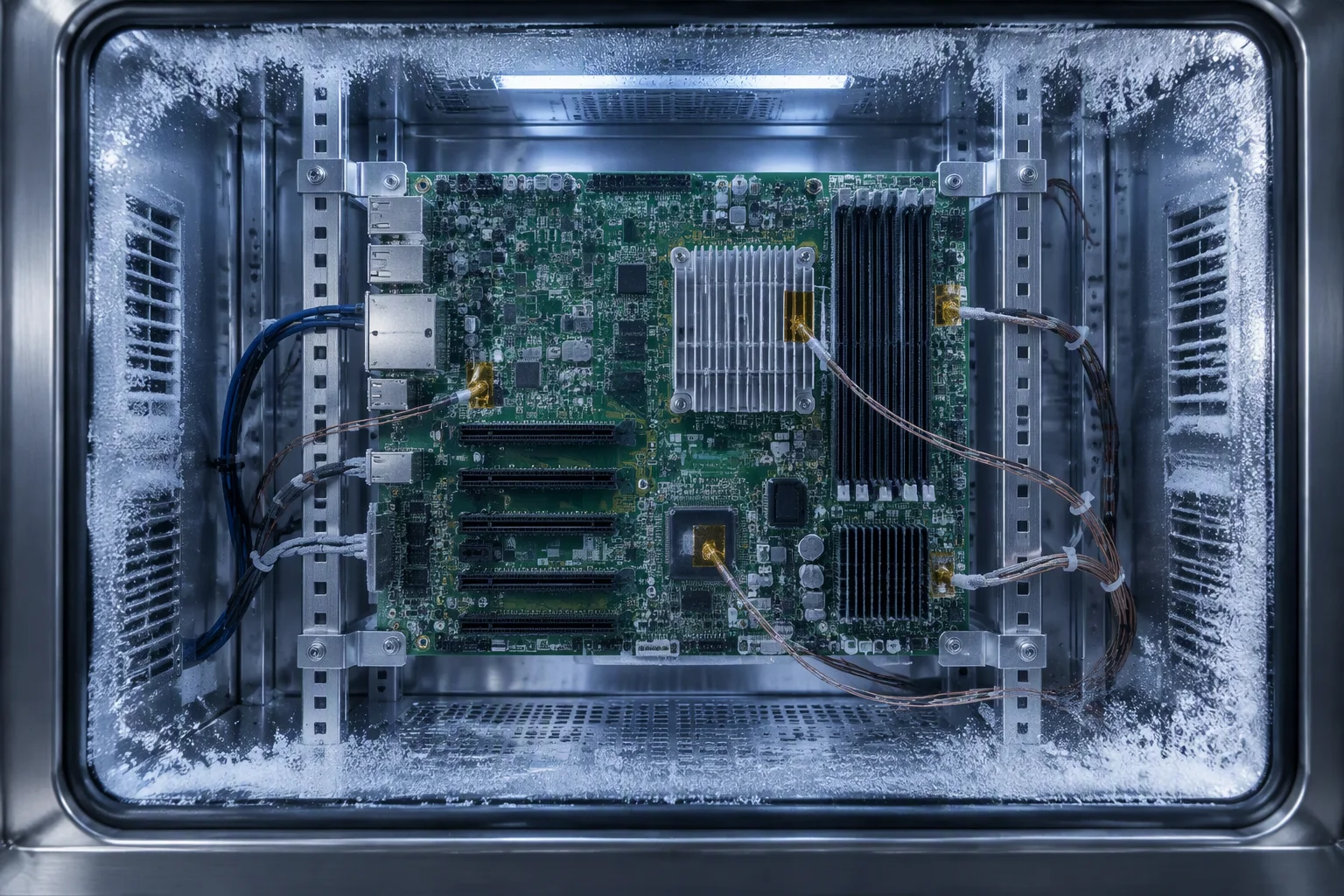
Industrial motherboard inside a thermal test chamber
Burn-in room · Shenzhen Photo: GEOLiNK factory

01 · Three temperature lines, not one

An industrial datasheet carries three separate thermal statements, and buyers often merge them into one.

  • Operating temperature. The ambient range in which the board is qualified to run continuously. Across the lineup this is typically −20/+60°C, with storage at −40/+85°C. Check the exact model, not the series.
  • Storage temperature. The range the board may see while powered off, including logistics. A −40/+85°C storage rating does not mean the board runs at −40°C.
  • Humidity. Almost always specified as non-condensing, but the window differs: the UT1003AW rates 0–90% RH while the AD742A rates 5–90%.

In a coastal cabinet that 5% floor describes the same air, but the guarantee window is not the same. Read the line for the SKU in your hand.

02 · Same format, different envelope

Here is the counter-example that proves the point. The TIM800B is a Mini-ITX board from the same 28 W Core Ultra class as the TOP800B. Its spec sheet rates operating temperature at −10/+60°C and storage at −20/+70°C, while the TOP800B rates −20/+60°C operating and −40/+85°C storage.

Same footprint, same family, different qualification envelope. If your site sees −15°C, the TOP800B is the defensible choice and the TIM800B is a field risk. Verify the number on the exact SKU you intend to order, and ask for the datasheet revision in writing.

Field note

The revision is part of the rating. R100 covers the UT1003AW, R101 the UT100NU, R102 the AD742A, R110 the FTEQ20A and R111 the HK800CA. Pin the revision into your design records: subject to change without notice is exactly why.

03 · Reference

Four DC input classes.

Every board sits in exactly one class. The practical distinction is which supply you already have: vehicle electrics, unregulated plant rails and battery-backed sites argue for 9–36 V; regulated supplies and 19 V adapters fit 12–19 V; a clean fixed 12 V rail can use the single-voltage class.

Reference · DC input

Input classes across the lineup

Model names and wattages from the English spec sheets. Wattage is the sheet rating, not a typical load.

Swipe to compare →
DC input classes, boards and sheet ratings across the GEOLiNK lineup
Input class Boards in this class Sheet ratings Best fit
DC 9–36 V UT1003AW · TL500Z3AW · AD600Z3AW · RP7003AW · MSK-TL5003AW · PNM-5210 90 W (TL500Z3AW, MSK-TL5003AW) · 120 W (RP7003AW) 12 V and 24 V vehicle electrics, unregulated plant rails, battery-backed sites
DC 12–24 V ITX660B 120 W and above · two power specifications optional Socketed desktop-class builds that must ride both 12 V and 24 V supplies
DC 12–19 V TOP800B · TIM600B · HK800CA · AD600NA · TL500CA · UT100CA · UT100NU 90 W+ on most models · 120 W (AD600NA, UT100NU) Regulated supplies, panel PCs and signage; the common 19 V adapter class
DC 12 V fixed AD742A · FTEQ20A · ITXD20B 60 W (AD742A) · 100–200 W (ITXD20B) Clean single-rail 12 V from a PSU, low-power nodes and instruments

Source: current GEOLiNK spec sheets · August 2026

See the boards

04 · Margin, current and the moment power returns

The class matters for three reasons beyond the label. Margin first: a 9–36 V board tolerates the voltage collapse of a 24 V system during cranking and the overvoltage of a 12 V system during alternator regulation, because both sit inside its envelope. A 12–19 V board needs a supply that stays in that window, which is why it pairs with regulated adapters and battery-backed bricks.

Current second. Wattage is the sheet rating, but at the low end of the rail the same watts mean more amperes. An RP7003AW rated 120 W on a 9–36 V input draws nearly double the current at 9 V that it does at 18 V. Size the input cabling and the upstream fuse for the low-voltage corner.

Power-on sequence third. For unattended sites the interesting line is not the voltage but what happens when mains or the vehicle returns. The HK800CA defaults to AT power-on by jumper, so it boots when power returns. The FTEQ20A, UT100NU and PNM-5210 expose AT/ATX headers for the same choice. Watchdogs close the loop: the TOP800B offers 0–255 s and the FTEQ20A 255 levels, so a hung process reboots without a person on site.

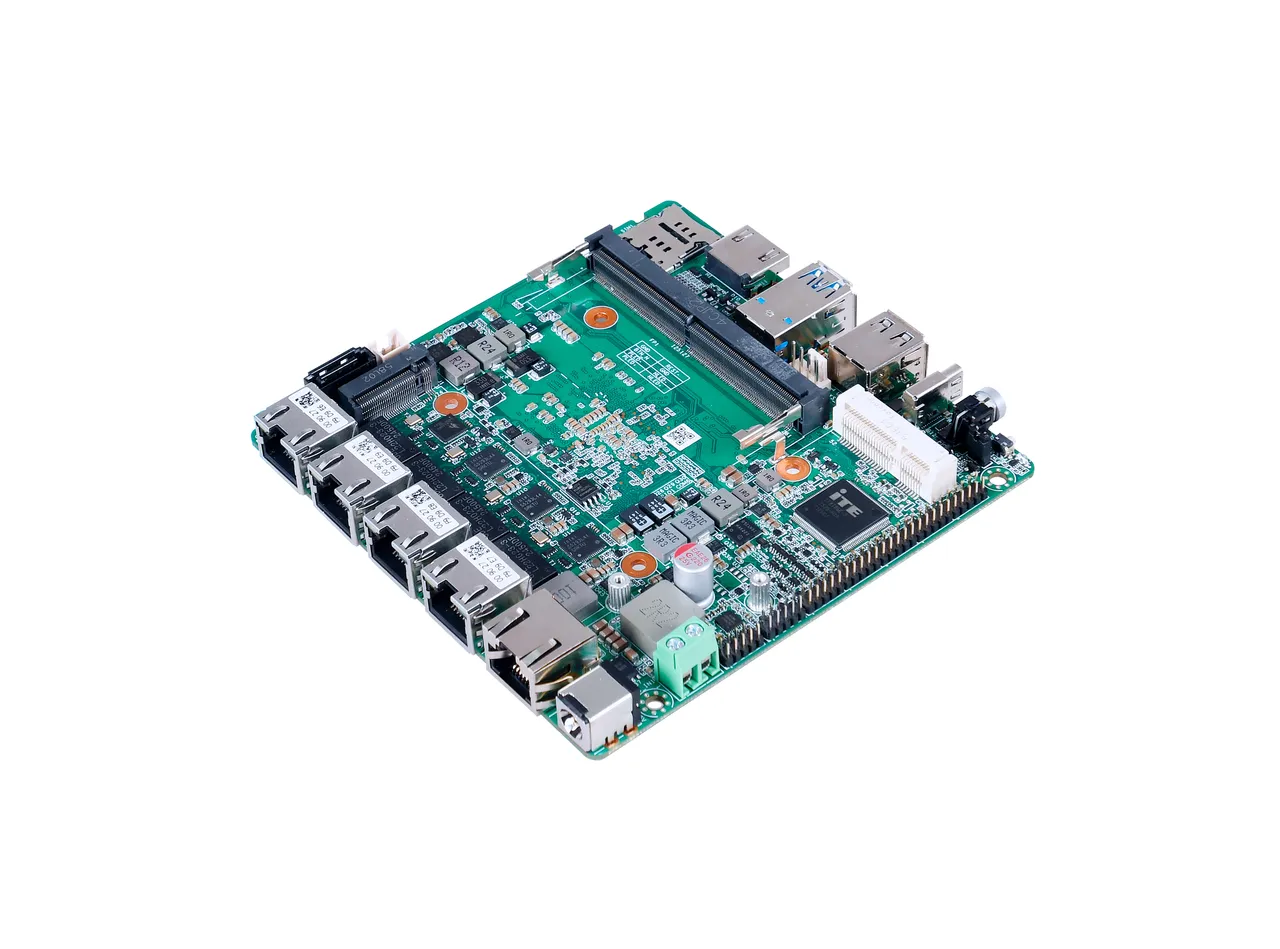
PNM-5210 NANO-ITX industrial motherboard with a wide-voltage DC jack
PNM-5210 · 120 × 120 mm DC 9–36 V · PoE 48 V, 15 W

05 · Eight checks before you specify

Eight checks, in the order they save money.

Takeaways

  1. Confirm the range on the exact SKU. TIM800B at −10/+60°C and TOP800B at −20/+60°C are both Mini-ITX. The series name proves nothing.
  2. Separate operating from storage. −40/+85°C storage is a logistics rating, not an operating claim.
  3. Match the class to the supply you already have. Vehicle electrics 9–36 V, regulated 19 V adapters 12–19 V, a PSU-fed single rail 12 V.
  4. Budget wattage at the low end of the rail. RP7003AW is 120 W and TL500Z3AW 90 W; derate the input wiring for 9 V.
  5. Read the humidity line. 0–90% and 5–90% RH, both non-condensing. Match it to the cabinet, not the brochure.
  6. Decide the power-on sequence. AT default on HK800CA, AT/ATX headers on FTEQ20A, UT100NU and PNM-5210.
  7. Check that the thermal solution fits the enclosure. The AD742A exposes a 4-pin PWM fan header, the TL500Z3AW carries a heatsink, the UT100NU reaches 345 g with heatsink.
  8. Ask for the datasheet revision. R100, R101, R102, R110 and R111 are all in use. Pin yours into the design records.

Most of the lineup already sits at the wide end, with −20/+60°C operating and −40/+85°C storage as the norm rather than the premium option. The remaining work is yours: verify the exact SKU, match the voltage class to the real supply, and bench-test a sample at both extremes of the rail before the mechanical design locks.

Qualify the environment

Tell us the environment. We will match the class.

Share the supply voltage, the cabinet temperature and the model. We will confirm the spec-sheet figures and quote a sample within 24 to 48 hours.

Sample MOQ 1 pc Reply within 24 to 48 hours FOB Shenzhen