01 · BIOS & logo
Boot the way your product should.
Boot logo, default settings, watchdog configuration and serial console redirection. Small changes can ride along with the first production batch.
OEM & ODM · Shenzhen
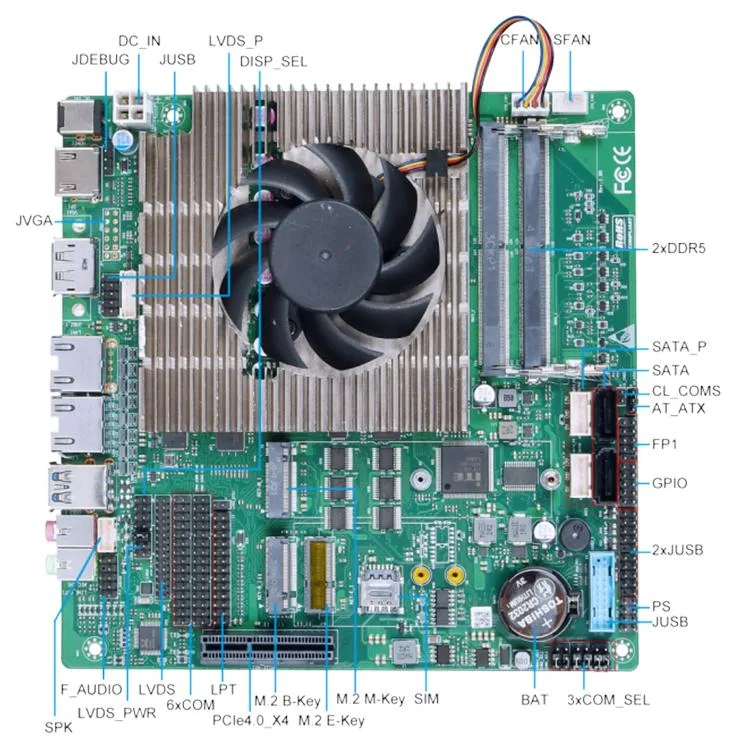
Six levers on a standard board. BIOS and logo, I/O pinout, protection, heatsink, packaging and silkscreen. Most projects start from a proven layout, not a blank sheet.
01 · The change list
Every item below is a real lever on a standard GEOLiNK board. Scope and cost are fixed in writing before anything moves.
Ask about a change01 · BIOS & logo
Boot logo, default settings, watchdog configuration and serial console redirection. Small changes can ride along with the first production batch.
02 · I/O pinout
Serial defaults, GPIO mapping and connector choice. Where the board layout allows it, the change stays on the standard PCB. Structural moves go to design review.
03 · Protection
Over-voltage, reverse polarity and surge levels set for the supply your product will see, from a clean adapter to a sagging plant rail.
04 · Heatsink
Affixed heatsink, fan headers and airflow guidance for the housing you actually have, including fanless builds where the case is the heatsink.
05 · Packaging
Cartons, inserts and labels prepared for your fulfilment or drop-ship model, with the part number and batch label your warehouse expects.
06 · Silkscreen
Your logo, part numbers and regulatory labels on standard board artwork. A low-impact change with little effect on lead time.
Also scoped in the same quote: CPU and platform, memory, network and wireless, display timing and full-unit builds. Ask for the full options list
02 · How it runs
Custom projects fail on scope, not on soldering. This sequence fixes the scope before anything expensive happens.
We confirm which of your changes are standard options and which need design work.
Change list, schedule and cost in one document. Nothing moves until you sign off.
Design verification on real units: BIOS image, I/O behavior, thermal margins and your tests.
Your configuration becomes the standard BOM for your part number, so reorders just work.
03 · Start here
A model number and a change list are enough to open the conversation. A sketch or pinout drawing speeds up the review.
The closest standard board, or the size and CPU class you need.
What must differ: BIOS, I/O, protection, heatsink, silkscreen or packaging.
Sample quantity and expected production volume, so the quote matches the bracket.
CE, FCC, RoHS or a medical program. Documents are confirmed per model and market.
A sketch, connector list or pinout drawing speeds up the review. CAD under a project agreement.
04 · Choose the path
Most programs start from a standard board. A full custom design is the right call when the enclosure or the platform cannot move.
Scope decision
Both paths are quoted in writing. The table shows where they diverge.
Swipe to compare →| Decision | Customized standard board | Full custom board |
|---|---|---|
| Layout | Proven PCB and platform stay qualified. | New layout, components and prototypes. |
| What changes | BIOS, I/O, branding, protection, heatsink and packaging. | New board shape, chipset or connector architecture. |
| Lead time | Standard lead time, plus project time for the change list. | Longer development cycle with design verification. |
| Best for | Most programs that need a product-specific board. | Programs where the standard layout cannot fit. |
Source: OEM/ODM FAQ · scope confirmed at quotation
Talk through the pathStart a custom project
One model number plus a list of what you need different. We will tell you what is standard, what is custom and what each change involves.