01 · Start with the footprint, not the brochure
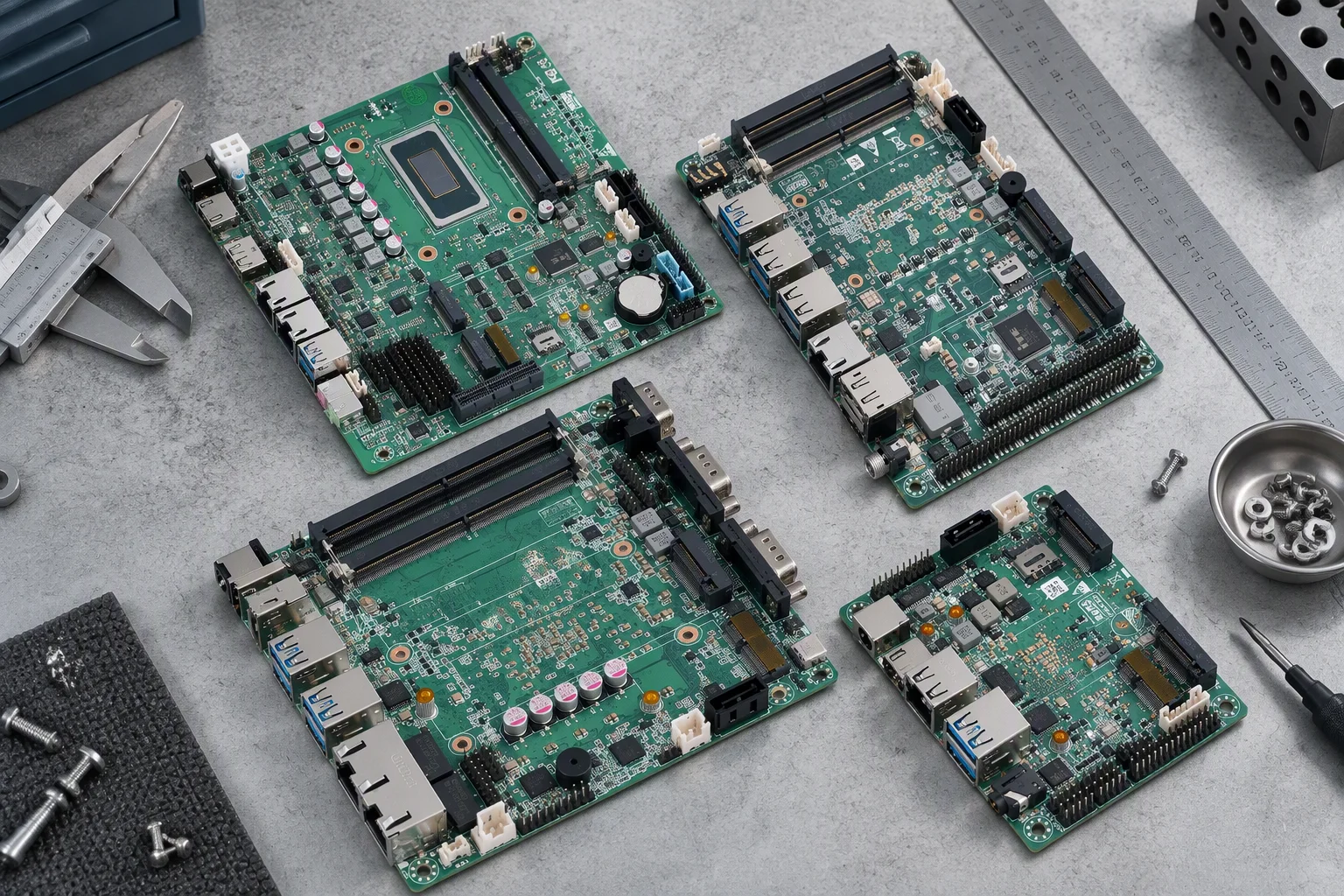
A 2.5-inch board at 100 × 72 mm covers roughly a third of the area of a Mini-ITX board. The gap shows up in every other row of the spec sheet: memory channels, network ports, serial channels and input voltage all scale with the floor plan.
- 2.5-inch · 100 × 72 mm. The smallest mainstream SBC class: soldered low-power memory, one network port, a handful of COM channels. Built for tools, sensors and portable equipment.
- 3.5-inch · 146 × 102 mm. The classic industrial SBC size: a real CPU as onboard silicon, two LAN controllers, six serial ports and a 9–36 V input stage. The workhorse of factory automation.
- Mini-ITX · 170 × 170 mm. The ATX-derived standard that fits a desktop-class platform: socketed LGA processors, PCIe slots, four display engines. The most flexible footprint for compute-heavy HMIs.
- NUC · 100 × 100 mm. A square footprint for slim fanless appliances: dense and light, two network ports and one or two M.2 slots, for routers, gateways and signage players.
Weight follows the same order, and it matters on DIN-rail builds. The AD742A is about 100 g without heatsink, the HK800CA about 120 g, the UT1003AW 160 g, and the socketed ITX660B around 400 g.
This guide compares the four footprints with one real board each: AD742A (2.5-inch), UT1003AW (3.5-inch), TOP800B (Mini-ITX) and HK800CA (NUC). Every figure comes from the English spec sheets, and all four rate −20/+60°C operating and −40/+85°C storage. The decision is about size, power and I/O.
02 · 100 × 72 mm: small board, tight discipline
The AD742A is the reference 2.5-inch board, revision R102. It runs an onboard Intel Alder Lake-N or Twin Lake platform, configurable as N100, N305 or N150, with soldered LPDDR5 up to 16 GB, a 4-pin PWM CPU fan header and a single-rail DC 12 V input rated at 60 W.
What you give up is I/O scale: one Intel i226-V port with optional PoE, two COM channels switching RS232, RS422 or RS485, two USB 3.2 ports, M.2 M-Key 2242 on PCIe 3.0 x2, one SATA 3.0, HDMI 4K and LVDS or eDP. Complete and quiet, but no second LAN, no PCIe slot and no wide-voltage option.
Choose 2.5-inch for a single sensor node, panel or instrument, a hand-held or DIN-rail enclosure, and a fixed 12 V rail you control.
03 · 146 × 102 mm: the industrial SBC benchmark
The UT1003AW, revision R100, packs the most capability per square centimetre. It takes an onboard Intel Core Ultra U or H processor at 15 W or 28 W (twelve SKUs from 135H to 255H), two DDR5 SO-DIMM slots up to 96 GB and a DC 9–36 V input.
Networking is dual: Intel i226-V plus i226-LM with AMT support. Field I/O is generous: six COM ports with COM1 and COM2 BIOS-selectable to RS232, RS485 or RS422, CAN, 8-bit GPIO, an M.2 B-Key for 4G or 5G with SIM slot and an M.2 E-Key for WiFi and Bluetooth. Display spans HDMI 2.1, DP 2.1, Type-C 4K and 24-bit LVDS or eDP.
Choose 3.5-inch when one machine talks to PLCs over serial, streams to a server over LAN and drives a local panel, and when a dirty rail argues for 9–36 V input. It is the default for vision stations, MES nodes and gateways.
04 · 170 × 170 mm: the standard that swallows a platform
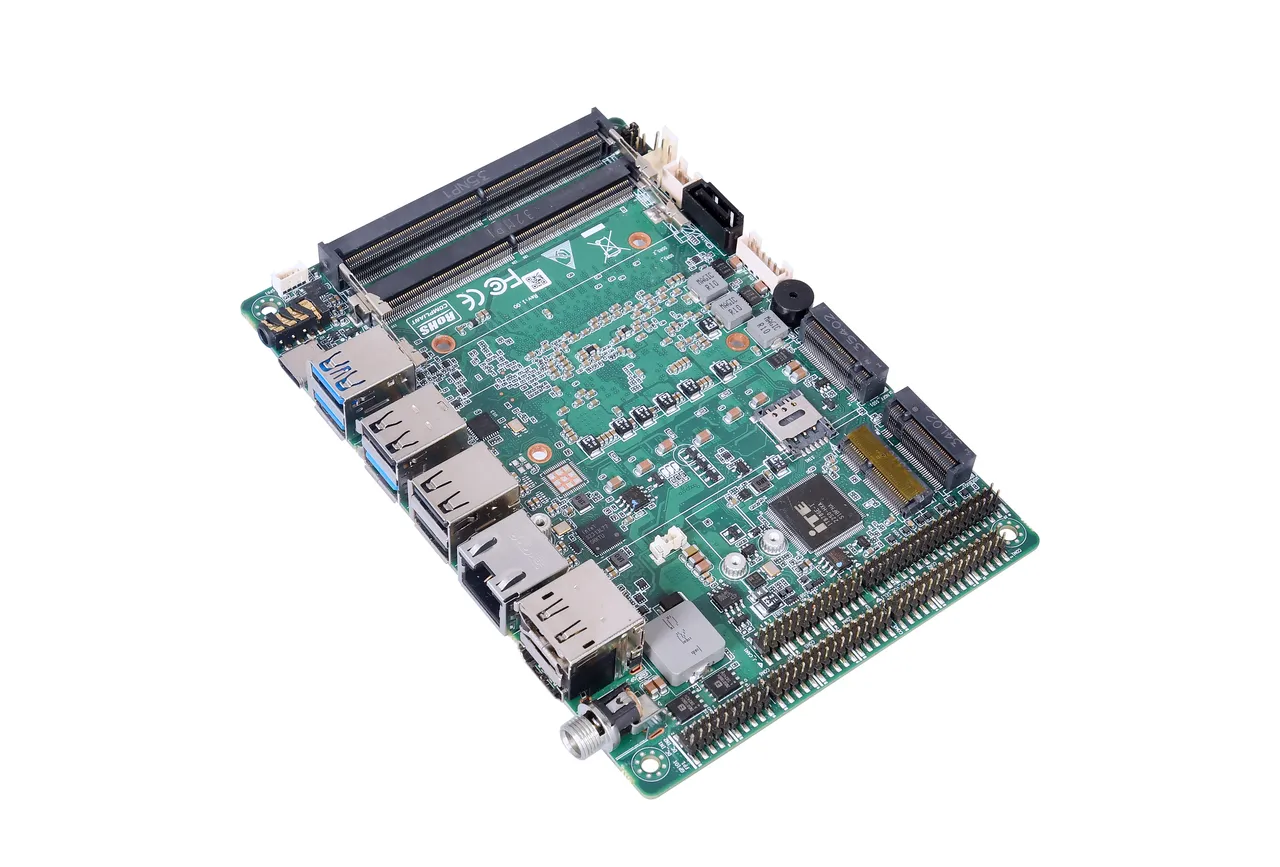
The TOP800B, revision R100, uses the Mini-ITX area for cooling and routing a full-size platform: an onboard 28 W Core Ultra 5 or 7 (Arrow Lake or Meteor Lake, including the Ultra 7 225H and 155H), two DDR5-5600 SO-DIMM slots up to 96 GB, and an HDMI 2.1 output at 8K 60 Hz for camera walls and surgical displays.
I/O scales with it: dual Intel i226-V 2.5G LAN, six COM ports with COM1 and COM2 selectable between RS232 and RS485, a PCIe 4.0 x4 slot, M.2 M, B and E keys, LPT or 16-bit GPIO, optional TPM 2.0 and a 0–255 s watchdog, fed from DC 12–19 V at 90 W and above. Teams that want a socketed CPU can take the ITX660B: same floor plan, LGA1700 at 65 W, PCIe 4.0 x16 and a DC 12–24 V input with two selectable power specifications.
Choose Mini-ITX when compute, display or expansion needs room: 8K signage players, advanced HMI, edge inference with M.2 accelerators, multi-monitor workstations, and any project that wants an enclosure you can source anywhere.
05 · 100 × 100 mm: density for the edge
The HK800CA, revision R111, is built for appliances that hang on a wall or ride in a vehicle, and it fits an onboard AMD Ryzen AI 9 365, two DDR5 SO-DIMM slots up to 64 GB and an M.2 2280 NVMe slot on PCIe 4.0 x4.
Connectivity stays appliance-oriented: two Intel i226-V ports, two HDMI 2.0 outputs plus a display-capable Type-C, one RS232 header, an M.2 E-Key for WiFi and Bluetooth, and AT power-on as the jumper default. The board boots when mains returns, which is what unattended sites need. Input is DC 12–19 V at 90 W and above.
Choose NUC when the product is a box, not a bay: routers, firewalls, signage players, fleet telematics. Need four LAN ports? The 120 × 120 mm NANO-ITX PNM-5210 carries three i226-V plus an RTL8156B, PoE 48 V at 15 W and a 9–36 V DC jack.
Field note
Two adjacent classes are worth knowing. The 120 × 120 mm NANO-ITX sits between 3.5-inch and NUC: the UT100NU fits a 28 W Core Ultra 125H or 155H, dual DDR5-5600 up to 96 GB and dual i226-V into a square footprint. The 155 × 117 mm 3.5-inch Wide adds the widest legacy I/O: the TL500Z3AW with DC 9–36 V, six COM, CAN and LPT.